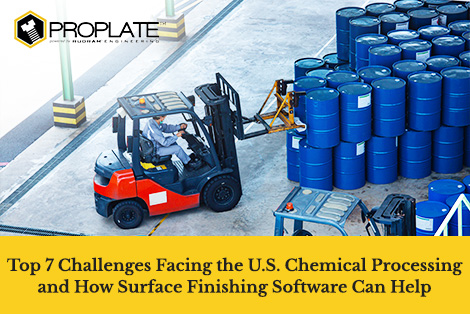
Top 7 Challenges Facing the U.S. Chemical Processing and How Surface Finishing Software Can Help
Top 7 Challenges Facing the U.S. Chemical Processing and How Surface Finishing Software Can Help The U.S. Chemical Processing Industry is the backbone of numerous sectors, including automotive, aerospace, electronics, and medical devices. Its role in surface finishing, chemical surface treatment, and advanced surface finishing makes it indispensable for industries that demand precision, durability, and performance. But alongside its critical importance come complex challenges that test the resilience of manufacturers every single day. Rising costs, sustainability demands, labor shortages, and digital risks are reshaping how the industry operates. For companies working in finishing and coating applications, these pressures are even more intense. At PROPLATE™, we’ve seen firsthand how digital solutions like surface finishing software and plating anodizing software can help manufacturers stay ahead. Let’s explore the seven key challenges and how forward-looking companies can tackle them. 1. Fluctuating Energy & Raw Material Costs Chemical Processing is resource-intensive. Energy, specialty chemicals, and treatment inputs form a large part of operational costs. Even small shifts in pricing can disrupt production planning. Without the right systems in place, companies often find themselves reacting instead of planning. That’s where ERP software for manufacturing adds value: Real-time visibility into consumption and spending. Smarter inventory management that prevents waste. Forecasting tools to balance stock levels with demand. The companies that thrive are the ones that can adapt quickly to cost changes without sacrificing quality. 2. Environmental & Safety Regulations Environmental compliance has become a daily responsibility for chemical processors. Strict standards around emissions, wastewater, and hazardous materials are non-negotiable in today’s market. Instead of viewing compliance as a burden, many leaders are reframing it as an opportunity to improve consistency and reliability. Surface finishing software can help: Automating reporting and documentation. Tracking every treatment bath and material usage. Reducing errors in handling and waste management. When businesses embrace compliance technology, they not only avoid penalties but also earn the trust of their customers and partners. 3. Supply Chain Vulnerabilities From global disruptions to supplier reliability, sourcing specialty chemicals has never been more complex. A single delay can halt entire production lines, particularly for advanced surface finishing operations tied to industries like aerospace and medical devices. Digital solutions give manufacturers more control: Monitoring supplier performance in real time. Triggering alerts when stock is running low. Rescheduling production with minimal disruption. Flexibility is the defining factor here. Companies that can adapt schedules and switch suppliers quickly maintain their edge in a competitive market. 4. Workforce Shortages & Skills Gap Like much of manufacturing, chemical processing faces an aging workforce. Many skilled operators are approaching retirement, and fewer young professionals are entering the industry. This creates gaps in knowledge, efficiency, and quality control. The solution lies in technology that empowers teams: Dashboards that simplify complex data. Automated systems that reduce manual steps. User-friendly plating anodizing software that helps new hires onboard faster. Instead of struggling with skills shortages, businesses can invest in digital systems that make teams—no matter their size—more capable and efficient. 5. Growing Sustainability & ESG Expectations Sustainability is no longer optional; it’s a competitive advantage. Customers, partners, and regulators are increasingly evaluating manufacturers on their ability to operate responsibly. This means reducing chemical waste, conserving energy, and showcasing transparency in reporting. With the right ERP solutions, companies can: Track energy and water usage in real time. Identify inefficiencies across production. Generate sustainability reports effortlessly. For those in the surface finishing industry, positioning as an environmentally responsible partner isn’t just about compliance—it’s about long-term growth and customer loyalty. 6. Global Competition & Market Pressures Chemical manufacturing is global, and U.S. companies often face competition from regions with lower costs. In markets where price is a deciding factor, American manufacturers must rely on quality, speed, and service to stand out. Here’s how ERP systems support that: Smarter production scheduling reduces lead times. Consistent quality checks build customer confidence. Integrated customer portals improve visibility and trust. The firms that succeed don’t just compete on cost—they differentiate through excellence in every part of their operations. 7. Digital Transformation & Cybersecurity Risks The industry is in the midst of a digital revolution. Tools like IoT, cloud computing, and AI are transforming chemical manufacturing and chemical surface treatment. But with digital transformation comes risk—especially cybersecurity. ERP systems help strike the right balance: Encryption and role-based security to protect sensitive data. Oversight tools to manage automation safely. Integration that enhances operations without exposing vulnerabilities. Innovation is powerful, but it must be paired with robust protection. Building a Resilient Future The challenges facing the U.S. chemical manufacturing industry are not small. But they also present opportunities for companies to modernize, improve efficiency, and position themselves as leaders. By adopting ERP software for manufacturing, companies in the surface finishing industry can: Reduce costs through smarter resource management. Ensure seamless compliance with environmental and safety standards. Empower their workforce with automation and user-friendly systems. Strengthen customer trust through transparency and reliability. At Proplate, we specialize in helping businesses navigate these complexities. Our chemical processing expertise and tailored digital solutions are designed to give manufacturers the edge they need in today’s competitive landscape. If your business is ready to adapt, grow, and thrive, our team is here to help. Contact us today to explore how PROPLATE™ can transform your operations. Schedule a Demo Download Now! 8 Proven Surface Finishing Techniques Every Professional Should Know PROPLATE™ delivers a range of features designed to help manufacturers optimize their barrel plating operations, reduce downtime, and minimize costly maintenance. Here’s how it works: 1. Predictive Maintenance: Prevent Issues Before They Happen PROPLATE™ uses advanced data analytics to predict when equipment might fail, allowing manufacturers to address potential issues before they cause disruptions. By continuously tracking the performance of barrel plating equipment—including motor speeds, bath chemistry, and barrel rotation—PROPLATE™ identifies patterns that indicate impending wear or failure. With predictive maintenance alerts, operators and maintenance teams can schedule repairs or replace parts proactively, minimizing unplanned downtime and reducing the risk of major breakdowns. This data-driven approach leads to more efficient operations, fewer